- Jul 22
We Changed Almost Everything After Our First Year of Homeschooling
- Ashlee Smiley
- Homeschool Planning
- 0 comments
When we started homeschooling, I brought years of experience in education with me.
I knew how to plan lessons, align standards, choose curriculum, assess learning, and build systems. I thought that experience would make the transition easier.
And in many ways, it did.
But it also caused me to make our homeschool feel a little too much like school.
I spent our first year creating lessons, combining programs, trying to cover everything, and carrying most of the instructional load myself. Some of it worked beautifully. Some of it was exhausting. And some of it simply did not fit Dani, our family, or the life we were trying to build.
So, as we prepare for our second year, we are changing almost everything.
Not because our first year was a failure.
Because our first year gave us the information we needed to make better decisions.

First, I Had to Understand What Homeschooling in Texas Actually Requires
In Texas, homeschooling families have a great deal of flexibility. Texas courts have identified the basic areas of reading, spelling, grammar, mathematics, and good citizenship for a bona fide homeschool program. Homeschools are not required to follow the complete public school curriculum or recreate every part of a traditional school day. The Texas Education Agency also explains that it does not regulate, approve, register, or accredit homeschool programs.
That gave me permission to stop asking:
“Am I covering everything a school would cover?”
And start asking:
“What does Dani need, and what can our family realistically sustain?”
We will still study science, social studies, literature, engineering, and other subjects because those things matter to us. But the way we teach them is a family decision based on Dani’s needs, our goals, and the kind of homeschool experience we want to create.
Our goal is NOT to do the bare minimum.
Our goal IS to create something rigorous, sustainable, and centered around Dani.
What We Learned During Our First Year
Our first year showed me that a curriculum can be good and still not be the right fit.
It also showed me that I do not need to create every lesson myself for Dani to receive a strong education.
As a former educator, creating my own materials felt natural. But constantly planning, teaching, adjusting, and managing every subject left very little space for anything else. It also made Dani more dependent on me than I wanted her to be.
This year, I am intentionally choosing systems that allow her to work more independently while still receiving the support, instruction, and accountability she needs.
The goal is the same.
The systems are smarter.
Literacy: Less Piecing Together, More Purposeful Support
Last year, our literacy plan included my Smiley Education Co. curriculum, Patterns of Power, and Words Their Way.
There were parts of that combination that worked, but managing several different resources required a lot of planning and coordination from me.
This year, we are simplifying.
Our literacy plan will include:
Lexia for independent reading, grammar, and vocabulary practice
Words Their Way for targeted spelling and word study
Novel studies for deeper reading, discussion, writing, and critical thinking
Words Their Way will begin with an assessment so I can determine Dani’s current spelling stage. She will work with one word list for two weeks, complete independent word-study activities, take a quick weekly check, and complete a spelling assessment at the end of each two-week cycle.
Novel studies will give us room to slow down and explore meaningful books without turning every chapter into a worksheet.
This combination gives Dani structure and independence while leaving space for us to have the deeper conversations I value.
Math: Keeping What Worked and Building Independence
Maneuvering the Middle was one of our strongest curriculum choices last year, so we are keeping it.
This is an important reminder that changing almost everything does not mean throwing away what worked.
For this year, I am planning to pair Maneuvering the Middle with Zearn Math. Maneuvering the Middle will remain our core curriculum, while Zearn can provide additional support with mastery, fluency, and independent practice.
I am still learning the Zearn platform and determining exactly how it will fit into our routine. I do not want to add a program simply because it looks good on paper. It has to serve a clear purpose and work for Dani.
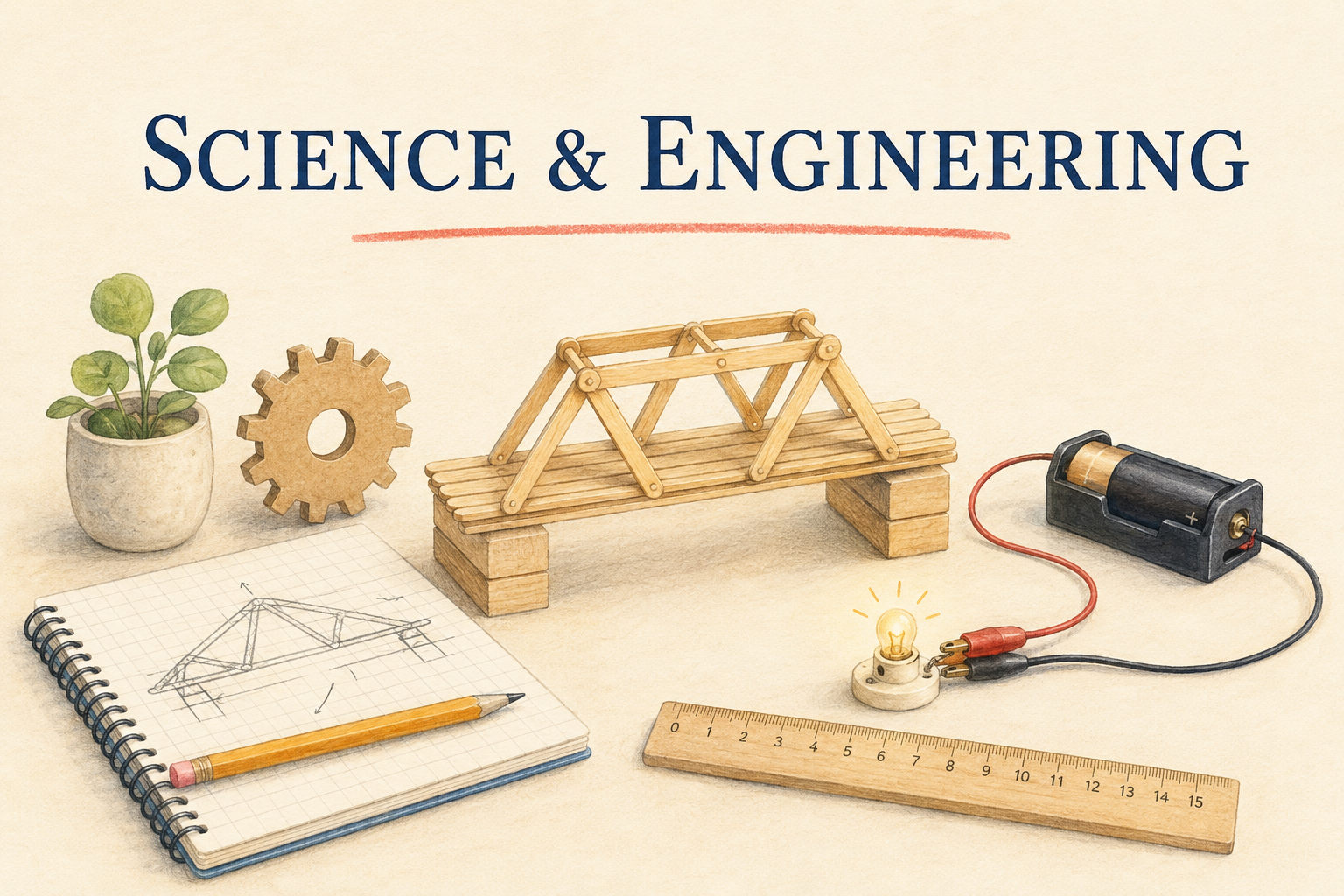
Science: Moving From Inconsistent Lessons to Engineering Projects
Science was not as consistent as I wanted it to be during our first year.
We did a little of this and a little of that, but we did not develop the kind of steady science routine I had imagined.
This year, engineering will be the anchor.
I am creating small-scale, home-friendly engineering projects aligned with both sixth- and seventh-grade Texas science standards. Because we did not cover every sixth-grade science standard last year, these projects will allow us to address important concepts from both grade levels in a connected way.
The projects will be:
Hands-on
Manageable at home
Aligned to specific learning standards
Challenging without becoming overwhelming
Focused on designing, testing, improving, and explaining
I want science to feel like something Dani experiences, not just something she reads about.
Social Studies and Citizenship: Building a Consistent Routine

Social studies was another area where we were not as consistent as I wanted to be.
This year, we will use Studies Weekly as our primary resource. I have already organized the content into a pacing calendar that fits our school year, grading periods, and scheduled breaks.
We will also use citizenship flash cards to reinforce important ideas in a simple, repeatable way.
Much of this work can be completed independently, which gives Dani more ownership and creates a predictable routine for both of us.

Our Schedule Is Changing Too
Last year taught me that flexibility only works when it is supported by structure.
This year, we are planning school Monday through Friday, but Dani will have the option to complete her work early and earn Friday off.
That gives us a full five-day school week when we need it, while still allowing her to practice time management and experience the reward of working ahead.
I want her to understand that flexibility does not mean avoiding responsibility. It means learning how to manage it.
The Biggest Change Is Not the Curriculum
The biggest change is how I am thinking about my role.
I do not need to prove that I can create every lesson.
I do not need to recreate the structure of a traditional school.
I do not need to fill every hour for our homeschool to be rigorous.
My job is to build an education that fits my child.
That means knowing when to teach directly, when to provide support, when to use a trusted resource, and when to step back so Dani can develop independence.
It also means protecting my own capacity.
A homeschool plan that completely exhausts the parent is not a sustainable plan, no matter how impressive it looks.
What I Would Do Differently If I Were Starting Over
If I could go back to the beginning of our first year, I would tell myself:
Start with your child, not the curriculum.
Choose fewer resources and give yourself time to learn how they work.
Do not assume that every subject needs to look like it did in school.
Build independence from the beginning.
Keep what works, release what does not, and allow the plan to change.
Most importantly, I would remind myself that the first year is not supposed to be perfect.
It is supposed to teach you.
Our first year showed us what Dani needed, what I could realistically maintain, and what kind of homeschool life we wanted.
This year, we are using those lessons to build something better.
Same goal. Smarter systems.
More independence for Dani.
More time and sanity for me.
And a homeschool that fits our actual family.